Saturday, 17 August 2013

Eureka / Excelsior Brickworks

Trading Name
Eureka / Excelsior Brickworks
Years of Operation
1889
Company Number
440954F
Address
Dandenong Road to the South, Lever Street to
the East and Park Road to the West, with the 
Brick pit to the North.
Council Lot No.
21,22,23
Coordinates
-37.894075, 145.095255
Current Use
Eureka . Excelsior Brick Works were on the site
 taken over by Evans Brothers Tile Works, now 
the site of the Garry and Warren Smith car 
dealerships.

Volume
Folio
Title Holder
From
To
1376
275075
Howard Tapley Clarton
27 Jul 1882
27 Apr 1885
1685
336948
John & Henry Goding
27 Apr 1885
10 Apr 1886


Universal Permanent Building and Investment Society
10 Apr 1886
8 Nov 1887
1685
336948
Edwin Wade
8 Nov 1887
28 May 1898
1685
336948
Henry Ethell
28 May 1898
21 Jan 1908
3251
650102
Abraham Baxter & John McKell
21 Jan 1908
21 Jul 1921


Oakleigh Brick Company
23 Jul 1921

9264
450
City of Oakleigh
20 Jan 1979


Another popular name for brick works.  Several companies called themselves “Eureka” as well as “Excelsior”.  Edwin operated under both names, which makes things a bit confusing because neither of them lasted long.  Described in their advertising as being “nearly opposite the Post Office”, the Eureka Brick Works were on the site taken over by Evans Brothers Tile Works.

John Wright (1858 to 1931) managed his father-in-law Edwin Andrew Wade's Excelsior Yard on the west side of Stamford Road.  Wade's daughter Frances Sale Wade, who was born at her parent's house on Broadwood Street in 1861, assisted her father and husband in the business.  They married in 1882.  Edwin must have been a poor businessmen because the Council was chasing outstanding rates from him in 1881 before he bought the site.  He owed 1 pound, but the Council settled for 12/6 after making an order for that amount.

John and Henry had been Firemen in Melbourne for many years and were obviously better firemen than brick makers.  They didn’t make a go of it and the property was taken over by the Universal Permanent Building and Investment Society.  They sold to Edwin Wade on the 8th of December 1887.  Edwin operated as Eureka until the 28th of May 1898 when he sold to Henry Ethell.

The following item appeared in the Oakleigh, Caulfield and Fern Tree Gully Times Saturday December 2nd 1905 in the Local News Column.  "A shocking fatal accident occurred about 4.15 on Wednesday afternoon. Mr. Charles E. Davis was driving a newly-wedded couple in his hansom to the railway station, and when at the junction of Dandenong and Neerim Roads saw young Jack Wade, who was learning to ride a bicycle, coming towards him. He was on his right side and gave the lad plenty of room, but just as he came abreast of the hansom he appeared to loose control of the machine and he fell with great force against the wheel of the vehicle. The cab was pulled up instantly, and Mr. D. J. Stein who was just behind and witnessed the occurrence, carried the unfortunate lad into Mr. Claney's house opposite and telephoned for the ambulance, but it was nearly 7 o'clock before it arrived. At an inquest held yesterday a verdict was returned of death from laceration of the brain and that no blame was attachable to anyone. The bereaved parents have been the recipients of numerous expressions of sympathy.”

If you want to see what type of bricks they made, look at the facade of the Mechanics Institute building in Oakleigh.  It appears that he was not crushing the shale as fine as many others because of the size and number od small pebbles and other gravel in the mix.


“Excelsior” was a popular name for early brick works in Victoria.  There was one in   Braybrook,  (cnr of Duke & Gloucester Sts) another in South Yarra, (between Melbourne High School and Chapel Street) and yet another in Frankston.  There appears to be no connection between them.  There were also “Excelsior” works in Sydney, as well as England and the United States.


Royal Commission 1914


Brick makers in Melbourne complained about the Co-operative Brick Company that was established in 1896.  It was alleged that the Co operative was responsible for high prices, poor quality, refusal to supply products and various other monopolistic practices.  In 1913, the Victorian Government established a Royal Commission that eventually determined that the Co-op was not a monopoly as some of the companies outside it were.  The First World War seems to have overshadowed the recommendations of the report and they appear not to have been implemented.  Despite complaints about the resulting price increases, the 1914 Royal Commission on the Brick Manufacturing Industry of Victoria found that the prices charged for Melbourne bricks were fair and the quality high.

A partial Government response was to attempt to introduce more competition by developing a State run brick works.  Land was purchased in Thornbury (now partly the site of the Aboriginal Advancement League) in 1908 and construction began.  The Co-operative then lowered their prices to 38 shillings per 1000 bricks.

This, and the controversy resulted in the project being stopped and the buildings being sold to Clifton Bricks.  Two years later, as part of the State Coal Mine at Wonthaggi, the State Brickworks was started.  Initially it was to provide bricks for the mine and to supply the railways.  It was also hoped that the cheap coal would produce competitively priced bricks for the Melbourne market.  Poor quality was alleged (supposedly by those associated with the Co-operative) and by 1912 the works were effectively closed.

By this time, a serious rival had emerged, in the Glen Iris Brick Tile and Terra Cotta Co started by disgruntled builders.  It had a site at Glen Iris but had to move to because the local Council and the Co-operative blocked access to the land.  An agreement was also entered into for a lease of Government land at Thornbury commencing in 1913 and to provide the State Government with bricks at a reduced price.

The Co-operative Brick Company Limited


In 1896, the Oakleigh Brick Company became a member of the Co-operative Brick Company Limited This company was formed by agreement between the Hoffman Patent Steam Brick Co., Northcote Brick Co. Ltd., New Northcote Brick Co. Ltd., Chas. Butler & Son and Fritsch, Holzer and Co., and registered on 10 September 1896. Authorized capital was £50,000 in 50,000 shares of £1. The word ‘proprietary’ was added and registered on 11 February 1897. Authorized capital was increased to £150,000 on 17 July 1927.  During its 70 years of business the Oakleigh Brick Co., Clifton Brick Co., Blackburn Brick Co., City Brick Co., and the Standard Brick Co. (Box Hill) became associated.  The company was taken over by Brick and Pipe Industries Pty. Ltd., William Street, Melbourne, in 1966.


In evidence before the Royal Commission, William Gardner Sprigg, Accountant said;

“It was a matter of common knowledge that the brick industry was in a very bad way.  A large number of kilns were closed, and those that were open were in competition so keen that most were losing money, and none was making a profit.

Various persons in the industry had spoken to me as to whether something could not be done to remedy, the evil.  That was early in 1895.  Several meetings were held with a view to see whether the live companies could not be made profitable by amalgamation into one.  The difficulties, however, wore considerable, and that course was abandoned.  Then at the request of some of the directors I called the representatives of the companies together to talk things over, and see if some feasible scheme could not bo devised for remedying the evil state of affairs.

The result was that it was agreed to form an association for regulating the price and output of bricks.  It was then felt that some provision must be made for the control of the large interests that at the time were in abeyance. Large companies had ceased work and were in the hands of financial institutions, and it was necessary, in order to make a safe association that some terms should be made whereby the closed yards and stagnant companies should get some return, and not be absolutely starved.  Ultimately I made terms with these idle companies through the banks, but it took many months, and it was not until the end of November that the association had completed such negotiations to enable it to carry on with safety.”

Holding Companies
  
A Holding Company or a Parent Company are companies that own other companies’ shares and usually refers to a company that does not produce anything itself.  Its purpose is to own shares in other companies. It does not have any operations, activities, or other active business; instead, it owns assets.  Holding companies allow for the reduction of risk for the owners and can allow the ownership and control of a number of different companies.

The thing that makes a holding company is that it has no day-to-day role in any of the companies, each is run by its own management team. In other words, as a holding company, the job is executive oversight and or passive investing, depending upon its’ corporate strategy. Its job is to put money to work and determine if Company management is doing a good job.  If it owns enough stock to control an investment, it can fire the managers and replace them at its own discretion.

A Parent Company is a company that owns enough stock in another firm (a subsidiary) to control management and operations by influencing or electing its Board of Directors.  Another benefit is that if the Holding Company goes bust, it does not affect the companies owned by them.  This was seen in the 1990s when a lot of long established English pottery companies were sold off (Usually by management buyout) by their Holding Companies.  Most are still doing well.  During the life of several of the brick works in Oakleigh, they were owned by holding companies.  For example, some of these being;

The Stamford Brick Company
Evans Brothers Holdings Ltd
Glen Iris Holdings
The Co-operative Brick Company
Brick and Pipe Industries

Sunday, 11 August 2013

Glen Iris Bricks

Trading Name

Glen Iris Bricks
Business Name
The Glen Iris Brick Tile and Terra Cotta Co Pty Ltd
Years of Operation
1912 to 1972
Company Number
ACN 004 063 843
Address
Stamford Road to the West and Estelle Street to the North
Council Lot No.

Coordinates
-37.892991, 145.101221  
Current Use
Public Open Space, Sporting ground

 The Glen Iris Brick Tile and Terra Cotta Co Pty Ltd began as a response to the Co-operative by disgruntled builders.  Office holders were Benjamin J Davis Chairman, Isaac Fenton Secretary and Charles Stacey Manager.  The company commenced on the Oakleigh site on the 5th of March 1912. 


In April 1912, an agreement was entered into by the Glen Iris Brick and Tile Company for the lease on a portion of land at Thornbury acquired by the late Sir Thomas Bent for the purpose of brickmaking.  Under the provisions of the contract, the company had control of of land comprising about 30 acres in all, for a long term.  They agreed to pay £150 per annum and to supply the brick requirements of the Government for seven years at 31/- per thousand. 


As the Government had only paid £5,000 for the whole area, the deal with the company, (bricks will be supplied for all state works at 7/- per thousand less than the current going rate) was regarded by the authorities as highly satisfactory.  No selling price to the public was included in the agreement.  This would depend on circumstances, but the  company has undertaken not to enter into any agreement with any other manufacturer of bricks in order to fix prices or regulate output.  It proposes to conduct its business on independent lines.


Everything was in readiness on the part of the company to start operations at once.  Up-to-date equipment had been manufactured for them by Messrs Anderson and Sons of Richmond who made milling machines and the power would be supplied by a suction gas engine manufactured by Kynoch Ltd of Birmingham, a munitions company still in existence, that had taken over the Forward Engineering Co that made the gas engines.  A Hoffman kiln and two drying chambers were to be erected and it was intended that everything in connection with the whole plant would be the most modern design.


It was the intention of the company at first to establish works in the neighbourhood of Glen Iris, hence the name.  Some 40 acres of land was secured at Camberwell on one side of Gardiners Creek and 6 acres in Malvern on the other side of the creek.  The intention of the company, the capital of which consists of 20,000 shares of £1 each was to build its brick making plant at the site of the clay deposit in Camberwell and to erect its kiln on the Malvern site.


Advertizement 1946

It was further proposed to cut up a portion of the area for workmen’s homes and to enable the land to be purchased on reasonable terms.  Anticipating that there would be no obstacles to an enterprise that it was thought would give employment to about 150 men.  The brick making plant intended for Camberwell be placed on the Thornbury land was ordered and the suction gas engine was arranged for.


The Camberwell Council however took action that prevented the company from starting operations there and caused the directors to turn their eyes in other directions.  A by-law of the council provides that neither quarrying nor blasting shall be allowed in certain areas.  This particular land came within the prescribed area and the council decided that the by-law should be enforced in regard to it.

Councillor Rooks, was a member of the Camberwell Council, and also a shareholder in the City Brick Company.  During his term of office as Mayor of Camberwell, he had a by-law framed stopping quarrying in the municipality, and thereby gave a monopoly to the Camberwell and Auburn Brick Companies, that were operating in the city at the time and not affected by the new bv-law.  Blocked on both sides, the company put its case before the Premier.


The brickworks from inside the pit.  
Photo 's courtesy of H.Gobbi, Taking its Place: a History of Oakleigh 

An offer was made to him that if he gave his support, the company would supply bricks at a reduced cost to the Government.  The Premier, Mr Murray suggested the erection of a kiln on the Thornbury Estate.   At a saving of 11/- per 1,000 during a term of 21 years (the length of time the company was to hold its lease), the Government would save £5,250 per annum, and £110,250 over the whole term.  He estimated that the income to the Government for the lease of the land, at £12.10/ per acre in 21 years would have been £3,150.

They were located on St Georges Rd in Thornbury, bordered by Miller St to the North, Watt St to the South and the railway line to the East. The site had first been promoted as a possible state brickworks in 1905 by then Victorian Premier, Sir Thomas Bent. Bent was unimpressed with the control that Melbourne’s major brickworks exorcised over the price of bricks and was keen to force a better deal for the government. 


The government had bought 30 acres of land in Thornbury in December 1904.  Bent was aiming to bluff the brick company cartel to lower their prices from 40 shillings per thousand.  After going as far as clearing the land and putting up buildings on the site, the brick companies conceded and dropped their price to 38 shillings per thousand. Development of the site was halted. However the fallout would continue to reverberate.

In mid 1905 the Auditor General had queried the purchase of the land, as the funds had been set aside for the construction and maintenance of workers’ homes in the area. Bent was later found to have misled parliament when he stated that the land had been bought for this purpose.  This, along with some other questionable land dealings, would bring about the downfall of Bent’s government in 1908.


By 1912 the land, which had been the subject of rumour ever since the brickworks were originally planned, had been subdivided and looked set to be sold.  Then, suddenly, in April of that year, the Murray Government, who had launched the original royal commission in opposition in 1905, announced that they had let a large part of the land in Thornbury to the Glen Iris Brick Company.

They began operations in 1912, and initially endured hostile press from the Leader and protests by local residents. But they stayed, and the government, having signed a long-term contract with the state government to supply bricks for thirty-one shillings per thousand, were thrilled with the situation. 


Glen Iris Brickworks, Oakleigh 1931

Though the brickworks has long ceased operation, the land remained crown until the late 1970’s when the Northcote Council suggested that the Aborigines Advancement League pursue developing the land for a new home.  Pastor Sir Douglas Nicholls had originally founded the League in 1958 with headquarters in Cunningham St.  In 1981 the Victorian Government ceded two acres of the old quarry land to the league as well as contributing part of the $750,000 needed to fund the building. This was the first freehold land granted to indigenous people in Victoria. The rest of the site is now devoted to the Sir Douglas Nicholls Oval and some housing blocks.

Under the terms of the original 1912 agreement, should the company combine with any other works or break any clause of the undertaking, the whole of the company's works would revert to the Crown.  The kilns anyway, would go to the Government at the end of 21 years.  It was believed that pressure had been brought to bear on the councils to stop the erection of the Glen Iris Company’s works


Brickworks 1945

The Glen Iris Company has been making bricks on a small scale for about two months.  As some difficulty in obtaining bricks for the kiln that was intended to build at Camberwell was feared, a small hand plant and kiln was placed on land at Oakleigh in order that requirements could be met.  These bricks would now be used at Thornbury.   As part of the deal, a railway siding was built to help transport their bricks.  There is a conspiracy theory that the State Brick Works was allowed to fail because of the Government deal with Glen Iris Brick Co and their ability to get bricks to Wonthaggi more cheaply than the locally made product.


Originally their capacity was four million bricks per-annum but in 1936, new kilns were opened increasing capacity by eight million bricks to twelve million per annum. Boral Bricks purchased Glen Iris in 1970.  By 1975 they had acquired almost 95% of the shares in the company.  Takeover was completed on the 4th of February 1976 when Glen Iris Consolidated Industries was de-listed by the Australian Stock Exchange.  Nothing remains on site except the remains of the brick pit that was filled as a Council garbage dump and is now a sports ground.


Glen Iris Brickworks, Stamford Road, Oakleigh 1968


Glen Iris Brickworks, Stamford Road, Oakleigh 1972

Saturday, 10 August 2013

Evans Brothers

Trading Name

Evans Brothers Pty Ltd
Years of Operation
1912 to 1972 (Sold Oakleigh site in 1969)
Company Number
C38607G
Address
Park Road Oakleigh
Council Lot No.

Coordinates
-37.894075, 145.095255
Current Use
Motor Car Trader and various commercial activities


Evans Brothers Tile Works;  Photo coutesy of H Gobbi, Taking its Place: a History of Oakleigh , p 185

Evans Brothers Pty. Ltd. tile works were located on the North side of Dandenong Road between Park Road and Lever Street on the site of the former “Excelsior” and “Eureka” Brickworks.  They dug their clay from the pit beside them.  The site occupied an area of approximately 2 hectares , to the East of the Oakleigh Hotel, Oakleigh, Victoria.    


Evans Brothers Tile Works Site 1931

The whole of the site formerly occupied by the tile works has since been converted into a car sales and service yard as well as various other smaller commercial operations to the rear.  A large car park now occupies the site at the rear and the remains of the demolished kilns lie covered in grass along the Scotchmans Creek.  Little trace now remains of the sites previous use as a brick works following its sale to the current occupiers.

The Group consisted of:

Evans Brothers Holdings Limited (The Parent Company) and,
Evans Brothers (Oakleigh) Pty Ltd
The Oakleigh Company made roof tiles and textured bricks.
Evans Brothers (Roof Tiling) Pty Ltd
This arm of the group did the installation of tiles.
Ceramic Brick and Tiles Pottery Pty Ltd
This branch operated the quarries and eventually took over management of their new Scoresby plant that succeeded Oakleigh. Following its sale to Gary and Warren Smith Motors in 1969.

Evans Brothers Pty Ltd
This Company was responsible for sales and marketing the products.

They first appear in the Sands and Mac Dougall Directory as tile makers in the 1911 edition.  The company was operating first in South Melbourne before moving to Oakleigh and taking over the old “Eureka” site.  In 1957, the following list of Directors was lodged with the Companies Office;

Reginald Charles Evans 15 Stewart Street, Brighton (1937) Married Murial Esme
John Cecil Evans (Cremated 28 Jun 1983)
Robert Winston Evans of Elwood (married Rae Marie Owen)
William Boyd Evans  born Albert Park Vic 22 Mar 1908 (NOK Marjorie)
Richard Reginald Bath
Victor Edward Arnold.  (Also the Company Secretary)
Evans Robert Winston born Elsternwick Vic 27 Jul 1924  (Mother Winifred
18 Martin St Elsternwick)

Clay came originally quarried from the pit nearby and brought to the works by conveyor.  It was milled while still moist and went through a pugmill where it emerged as a continuous mass onto a roller table where it was cut into blocks  These blocks were transported into a double sided press where they were shaped into tiles.  Excess water was expelled during pressing.  At the Evans Tile Works, the green tiles moved from the press onto a conveyor belt where they were trimmed by hand of any surplus clay.  

Tiles were then put onto trays and moved to the drying racks where they dried for up to two weeks.  They then moved to the drying floor where they were placed on racks to dry.  After drying, they were packed onto a barrow that was placed onto a lift and lowered to where they were loaded into the kiln.  The dried tiles were fired in stages at up to 1100C.  After cooling, the fired tiles were removed, graded and stored ready for shipping. Drying was done upstairs where the heat from the kiln was ducted to aid the process.  They dried for up to two weeks. 


Evans Brothers Site 1945

In November 1957, the company increased its share capital by the addition of 95,000 shares valued at £1 each, beyond the registered capital of £5,000.  Clay was being transported from a site at Tally-Ho, further north to Oakleigh.  In 1961-62, work commenced on building a modern production facility in Scoresby, Victoria.  Oakleigh was becoming old and in need of updating.

In 1965, a second tunnel kiln was built at the new plant and the Oakleigh tile works suffered their first financial year loss.  Evans Bros. had purchased additional land at Scoresby, bringing their total holding there to 68 acres.  A new automated tile works had then been built at Scoresby and the Oakleigh Tile Works closed in June 1967 as it had become uneconomic.  The land on which it stood was sold to Garry and Warren Smith, car dealers in 1969.  A Directors report for Evans Bros. of 1971 says; “The Directors advise that this Company did not transact any business during the year ended 31st March 1971, and no profit or loss was made for the period.”

All trace of their brick works is now long gone, but there is still a building on site the car people call “The Evans Building”.  Warren Smith recalls the demolition of the chimney being televised and the duplex homes on Dandenong road being demolished to make way for the Car Yard.  Weatherboard workers homes in Park Road were also sold and relocated.

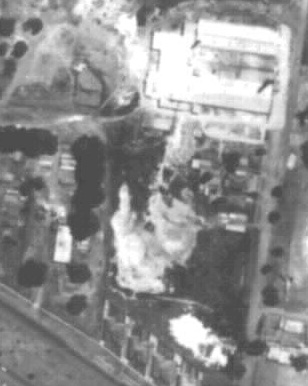
Aerial view of Evans Brothers Tile Works in 1931 showing the works at the top with the claypit in the centre, Dandenong Road at an angle at the bottom and Park Road to the right.


Evans Brothers Tile Works 1968

The works has expanded considerably since the 1931 photo.  Note the row of brick duplex cottages along Dandenong Road. Weatherboard homes on the west of Park Road are also visible.


Evans Brothers Tile Works, Oakleigh, Late 1940s

As seen here, bricks  and tiles had there rough edges trimmed.  Here, workers use their hands. but often a wire called a “bow” was used on the soft clay in the moulds.


Tile Cleaning, Evans Brothers 1947

"In February 1969, Garry and Warren Smith became a General Motors-Holden Dealer and took over the long established business of Williams & Sons in Atherton Rd, Oakleigh. One of the conditions upon appointment by GMH involved closing various used car outlets. Prior to taking on the GMH franchise 8.5 acres was acquired in Dandenong Rd, Oakleigh from Evans Brothers. Previously the property was a brickworks and quarry"


Demolition of Evans Brothers Chimney 1969

Saturday, 3 August 2013

Australian Plaster Industries Pty Ltd

Trading Name

Australian Plaster Industries Pty Ltd
Years of Operation
(Incorporated 1926) in Oakleigh 1939 to 1985
Company Number

Address
73 Westminster Street Oakleigh, Bounded 
by the Railway Line to the South, 
 Westminster Street to the East and 
Downing Street to the West.  Factories 
on Regent Street are to the North. 
Council Lot No.

Coordinates
-37.904251,145.094279
Current Use
Vacant land covered with concrete floor


Bricks are only part of the story in Oakleigh.  The bricks may go on the outside, but plaster goes on the inside.  Usually wood goes in between.  The Foresters Arms Hotel is a remnant of Oakleigh’s long vanished timber industry.  As late as the 1890’s wood cutting competitions were still being held around town, but I digress.  I am including this story in memory of my Uncle Frank, a plasterer.

Going back a few years, the “Australian Gypsum and Whiting Company” was started in South Australia by William Robert Innes, after whom the town of Inneston and nearby National Park was named.   He began mining gypsum at Marion Bay to make plaster.  This is where the raw material came from for making plaster in Westminster Street.  After manufacturing ceased in Oakleigh, plaster making began at Marion Bay.

Old Gypsum Mine, Marion S.A.

Plaster can be made into fibrous plaster, plaster board, plaster moulds for pottery and cornice mouldings as well as other plaster decorations.  Some of you of mature years will have had a plaster mould taken when the Dentist fitted you for your false teeth.  It’s manufacture is a simple three stage process.

Plaster has been used by us for over 4000 years as a building material and is made by heating gypsum to 150 °C.  This first stage of the process is called “calcination” and removes water from the gypsum.  Before it is dried, the gypsum is dried and ground to a fine powder in a heated mill.  Next it went into large steel kettles where it was heated by gas burners and stirred with paddles to prevent overheating.  The powder was then put into hoppers to cool the plaster.  It was ground again and stored for further processing.

At this point it was known as stucco or Plaster of Paris, so called because the original deposit of gypsum was found under Montmatre in Paris.  It is one of the reasons why there are no high rise buildings there.  The ground underneath Paris is honeycombed with tunnels, not all from mining gypsum.  Some of the plaster was sold at this point as “Plaster of Paris.”

Rehydration is the second stage where the dried plaster powder is mixed with water and any other additives until it forms a thick paste, or slurry.   Some of the additives, such as starch are there to help the plaster bond with the cardboard, others are as thickeners.

The third stage was setting or simply to allow the plaster to dry by evaporation.  It comes out of moulds easily.  Some is dried to 250°C for around an hour.  Plaster board was put onto drying racks where they were stored until needed.

As well as its brick works, Oakleigh was also home to many industries associated with the building industry.  One of these was Australian Plaster Industries Pty Ltd.  Approaching what is left of one of the Oakleigh sites is like seeing the jagged remains of a broken tooth.  Sitting forlorn on a pad of windswept concrete, it waits for action on its future.


The site occupies an area of approximately 2 hectares on the Southern side of the railway line to Dandenong to the East of the Oakleigh Railway Station, Oakleigh, Victoria.    The majority of the site formerly occupied by the plaster works has been demolished with the chimney, part of the boiler house and one hopper remaining.  The remains have not been well secured and have suffered from vandalism and graffiti. 

The concrete floors and some foundation walls remain to show the sites previous use as a brickworks following demolition of the sheds after sale to the current occupiers.  A part demolition of the remaining chimney in 2009 has caused controversy and some adverse publicity.


Aerial View of the Now Demolished Plaster Works

The site was originally occupied by the Turbine Pulmotor Company Pty Ltd until 1930.  Even back in the 1920s, Oakleigh had advanced technology being manufactured there.  The Turbine Pulmotor Company Pty Ltd manufactured the “Pulmotor”, an artificial respirator machine that pumped either air or oxygen into and out of a person through a mask or tracheal tube.  Pressure was regulated to prevent damage.  It was believed successful in helping stillborn babies to breathe.  Short for Pulmonary Motor, it was a portable device patented in 1907.  Reports of its success were mixed. 


Next came the Concrete Specialty Company, then Australian Plaster Industries.  Boral Australian Gypsum were the last occupants of the site.


The plant was built c.1946-48 as part of a new plasterboard factory for Australian Plaster Industries Ltd. The briquette fired water-tube boiler supplied steam for drying plasterboard until it was made redundant by direct firing in 1970. The saw tooth roof brick building with steel window and roof trusses housed the main board production machine as well as warehouse facilities. It was built in two stages, being doubled in size in 1958.

The factory is significant because in 1948 it was the first factory in Victoria where plaster board was manufactured on an industrial scale. Plaster board changed the way buildings were constructed by greatly improving the efficiency of construction through the use of large sheets of pre-made plaster board for lining internal walls. This board was erected dry, eliminating delays caused by waiting for older style lathe-and-plaster to set; it was also more amenable to mass production and easier to install than fibrous plaster sheets. The plant was strategically important to Australia's construction industry during a time of intensive building activity and material shortages following World War Two. 

Aerial View 1945

The chimney has an aesthetic significance as a tall prominent feature of the local landscape associated with the industrial use of the area. It is easily visible from the surrounding area and from the adjacent railway line. Once common, large brick chimneys associated with industry are few in number and increasingly threatened with demolition. Many have been truncated, or had their associated boiler house, kiln, or factory which used the heat or steam, demolished.
Classified: 06/07/2009

The boiler house and chimney are a rare example of a large and relatively intact boiler house and chimney associated with the post war period of Victoria's industrialization. The location of the boiler house adjacent to the Gippsland railway line is historically significant as it was specifically located next to the railway line to enable the delivery of fuel for the boiler. 


The use of briquettes as a fuel has largely been replaced by natural gas, but the closure of the boiler house in 1970 resulted in this plant not undergoing the conversion to natural gas which has occurred at most other boiler installations. As a result of this, it is one of the few surviving examples of a large briquette fired water-tube boiler and associated brick chimney in a manufacturing context in Melbourne. It provides direct evidence of the Latrobe Valley briquette industry which underpinned Victoria's industrial development from the 1930s until the 1960s, during which time production of briquettes more than trebled. The use of SECV produced briquettes provided a cost effective fuel for industry and reduced Victoria's reliance on black coal from NSW.
1950 Expansion

The boiler house was once a large and relatively intact example of an industrial boiler complex. The boiler, chimney, briquette overhead storage bunker, briquette elevating conveyor, mechanical stoker, and steam driven feed pump are all still present, but theft, exposure and vandalism has taken its toll.  Anything of value has been stolen and the exterior cladding is now long-gone.  The four-drum water-tube boiler, built to a design by John Thompson & Co., Wolverhampton, was probably made at their local West Footscray factory.  It is a rare surviving example of a once-common form of industrial plant: water-tube boilers played a key role in Victoria's twentieth century manufacturing development; they produced high volumes of steam with greater efficiency than conventional fire-tube boilers; they were also inherently safer.


The plant also pre-dates the construction of fully unattended automatic boilers and is illustrative of the work practices of the period which required a full-time boiler attendant. Boilers were installed by industry to generate steam for use in manufacturing processes, driving steam engines which in turn drove line shafting, or for steam engines and turbines driving electricity generators. The advent of the SECV in the 1920s and the development of the state power grid saw a reduction in factories generating their own power. By the 1940s the main reason for building a new boiler house was to provide process steam. This boiler house provided steam for heating at the drying stage of plasterboard production.

If you want a more detailed report on the property, click on the link below.